I had a thought and decided to write it down. Welcome to the rantings of someone who decided to write down his thoughts on mysticism, politics, anthropology, science, and art.

Thursday, March 24, 2011

Apos Tekton Theos : Or The Self Behind The Curtain

Many architects love to charmingly reference Louis Kahn's conversation with the brick. For those unfamiliar with this idiosyncrasy, the convo classically goes a little something like :

Lou : What would you like, brick?
Brick : I would like an arch.
Lou : Oh brick, arches are expensive and difficult to construct. I could really use you over a concrete post and lintel construction.
Brick : But I would like an arch.

Architects like to use this example of the architect deriving the architectural design from the architecture itself; that the design, the materials, the structure, the site, or anything relating to the building design process should be derived from an intercourse with the design.

But in all actuality it's really just some crazy old guy talking a brick. The problem is that the metaphier of the design process is the paraphrand of a poor metaphor in a rapidly secularizing era of society.

Why must architects continue to "talk" to the building design as a means to develop the architecture? Architects are using a conceptual construct of their own creative imagination and conversing with the deus ex tectonicus, which is only a metaphor for the architect him / herself. And it is such a poor metaphor really. Architects (and any designer / artist / poet) can just cut god out of the equation and simply ask themselves what they want in their work.

It is rather odd that we would think it to be god out of the machine, when a more proper translation from the Greek would mean "god of our making" or "god out of our creation", since the machine is of our making. We can dismiss mysticism in a secular age of construction, but while architecture exists almost purely profane in the contemporary age, mysticism has not left the scene at all : it has only changed its form. We still talk to our creations as third party divine entities that have a conscious notion of what they "want" to be. When in all actuality it is really only us talking to ourselves via a poor metaphor of our creative imagination. And, to top it all off, we teach the usage of this misleading metaphor in architecture schools!

John Locke : I've done all you've asked of me! What do you want me to do! Tell me!
Then there was light.

Tuesday, March 22, 2011

EVERYTHING Is Good For You In Moderation

We have all been told wine is good for you in moderation. Duh. A new study reported on the Today Show discusses that coffee is good for you in moderation. Coffee has health benefits, such as "wakefulness" "increases cognitive ability" and "increased muscle coordination and strength." It also helps the heart and a bunch of other stuff like that... No kidding, that's why I drink two pots of coffee a day. Then again, that is why my teeth get stains and I'm wired every night and groggy every morning. Brewing a fresh pot of joe at midnight is not moderation.

That's why they always throw in "moderation". But everything is good for you in moderation. I bet Guns n' Roses and Iron Maiden is good for an in utero fetus in moderation because of its intensely sophisticated audio stimuli that will increase a child's ability to work with system rules at intensely fast rates. But, of course, only in moderation or they may turn to harder bands like Deicide and Emperor and end up like me : some guy working retail because he can't get a job at an architecture firm while he does freelance work on a $250 million Masonic Library and Museum in Texas, even though no architecture schools want to accept him so he can finish his Masters... but that's another matter. Cigarettes are good for you in moderation : after you eat they semi-clean the teeth (that's supposed why the French and Italians do it) and it dilates the arteries and increases blood flow.

I can't think of many things that are not good for you in moderation. Cyanide is probably good for you in moderation, probably only trace amounts (like the amount in a cigarette), but that's moderation! It has shown that swearing is good for you in moderation. Just when you think you can't take it anymore and you just yell "Fuck!" really loud has shown to reduce pain and increase satisfaction (whatever that means).

Here is the real test : just type in anything into a search engine and add "is good for your health" at the end of your item of inquiry and see what you get. Practically anything you can think of will be good for you, but somewhere in the article it will say "in moderation". Currently the only things I have found that were not studied to be good for you are :
-Anal sex with Adolf Hitler's corpse
-Bill O'Reilly's grandmother's cat
-Turning the lights on and off until the bulb blows
-... ... ...

Okay, it will actually be a long list. It could practically turn into a Cantor Set of sorts (i.e. for every positive element to your health in moderation will correspond to something not yet studied to be good for your health... ad infinitum). But we could easily break up each inquiry into smaller parts and test them. Anal sex is good for you in moderation (at least no negative effects). And so are corpses (i.e. organ transplants and medical experiments). But Adolf Hitler has been found to not be good for your health (if you're not of the white Christian Aryan race)... so the first can be concluded as a NO / MAYBE. Bill O'Reilly, grandmothers, and cats have found to have positive effects on health (so says Bill O'Reilly). So YES(?) Lights either on or off have positive effects to your health in moderation. Blown light bulbs have yet to have been tested, so the third is inconclusive.

The point here is that common sense has turned into an imperative authorization to continue to do the things we love. Men like to masturbate. We just do. Recent scientific evidence has shown that sperm start to deform after 36-48 hours and will, therefore, have difficulty in getting to egg. Masturbation allows males to get rid of the old sperm and generate fresh new ones that are more capable for fertilizing an egg. Now we have an evolutionary excuse. But why do we need an excuse to masturbate? Why can't "I just felt like it" or "I was horny" or "I was bored" or "I just like to" be sufficient enough?

I like to drink coffee and smoke cigarettes, albeit more than moderately (by a long shot). But the next time someone tells me why I should quite smoking or not drink coffee I can always throw at them medical evidence of how it is good for you in moderation. That's the point of all this "medical evidence" : to authorize every decision we make that can be scrutinized for their negativity. We haven't come very far in our ways of progress (whatever that means). Before the gods had to tell us what was good or bad. Then came the kings, emperors, Caesars, and Popes. Now we have scientist and their medical evidence. Why can't we just do the things we enjoy and accept the costs of having a bit of fun and pleasure without authorization from any but ourselves?

"I'm willing to take seven years off my life in order to not sound like one of you whiny non-smokers."
~Bill Hicks

Thursday, March 17, 2011

"I'm not a Communist. I believe in community oriented societies."

Even after Daniel Tosh poked fun at anyone who says, "I'm not religious. I'm spiritual," in which he remarks, "I'm not a liar, but you're interesting," people still say it. Likewise, with the current trend of communal social orientation people are arguing for a denouncement of individualism and for the propagation of concern for the community; simply because the whole is always stronger than the individual.

I can't count the number of times in which that argument has been proposed in architecture / urbanism discussions amongst friends and peers (though the number is probably rather small). One of these arguments occurred the other night, more or less (thank you for discussion, by the way kiddo). So here is my retort forever (and by forever I mean for as long as I care to be concerned) : "Move to China! They are community oriented and denounce individualism. Your concept is not new. It's called Communism, and to your delight it is a very successful system. In fact, that is where the word 'Communism' comes from : community."

Really what is being argued for is that we should all live in communes or live under Communistic rule. Of course, in our Socialist-Democratic nation we see Communism as a negative, usually because of Hitler and Stalin. But Communism is a very successful system, and I say that based on evidence. Now, usually people say something like : "Well, it works well on paper, but doesn't work in practice." Well if that isn't the truth with everything, then I don't know what is. A circle has an infinite number of angles in mathematical theory, but in reality it has a finite, though very large number of angles, which is the result of Planck's Constant (the smallest measurement due to the materialization of quanta particles).

No, Communism does work in reality, and there are some good examples. Communism is the most basic and primitive form of governance, and it is common in the animal kingdom. For instance, ant colonies are a Communistic rule. The queen ant is little more than a slave for breeding. The warrior ants are even less useful, usually being sluggish and don't really do any fighting (which is done by the workers). The drones do little more than breed with the queen. It is the worker ants that rule the colony. They have a very successful caste system that is dynamic amongst the individual ants, but is constant amongst the group. It is the workers that propagate the success of the colony, and queen takes little credit for anything. Bees have a very similar social caste / governance system.

With mammals the situation changes dramatically, because mammals usually have fewer numbers than ants and bees. But the concept is still similar. There is usually a leader with primates and beasts. The leader's reign is always subjective to his generosity towards the group. Once the leader becomes tyrannical, usually another male will challenge his authority. But, of course, the workers can always leave the leader, which is why amongst primates the leader tries to help out a lot (also, he usually does this because if he does a lesser subject a favor, then that subject must be faithful to him as payment for the favor). Of course, each system is different, and I am greatly over generalizing here only because it's not necessary to get detailed.

Regardless, Communism does work in practice. The only thing is that it doesn't work well with humans, because of our lust for power, and with that more power. I personally favor individualism, but that is another account. Really the point of this post is : just say it like it is. If you want Community-oriented societies, then just say Communism and move to China.

Wednesday, March 16, 2011

Your Old Road Is Rapidly Agin'

Welcome to the technology generation, and an era of social connectivity. Now, right there someone might say that technology has greatly disconnected social interaction. But this could not be further from the truth. It's just that the old farts do not want to get out of the new road because they can't lend a hand.

The argument I am accustom to goes a little something like this : "Children just sit inside and play on the computer... they don't go outside and play in the neighborhood with other children. No one meets in the public square anymore on a lovely spring afternoon to chat with a lifelong friend... they'd rather do work in a Starbucks." It's not like they are being antisocial. Humans are social creatures and we won't let something as silly as walking to California stop us from interacting with someone in LA.

Nothing in the ways of social interaction has changed, only the form in which interaction takes place has changed. Rather than children playing cops and robbers over at Jimmy and Sally's house, they play WoW and kill monsters with Jinn in Korea and Hansel in Germany. But what a double standard youths of this era face, they are told to get off the computer and go play in the neighborhood... BUT, keep your cellphone (with GPS) on, and call your mother when you get to Jimmy's house, and make sure mother talks to his parents so she knows you're not lying and out doing drugs behind the Kroger where men in vans with candy might kidnap, rape and kill you and leave you bound in electrical tape on the side of Highway 17. And be back before 5:30 or mother will have to call every parent in the neighborhood to find out where you are!

When I grew up I could go anywhere in the neighborhood and my parents didn't have to know where I was or what I doing, so long as I was back by dinner. My mother used to tell me how she would ride her bike into another county, and didn't have to tell my grandparents where she was so long as she was back by sundown.

Technology has allowed social interaction to take on a whole new dynamic form, as it always has. I can express this with a little mathematical endeavor. Let's say I had to have social intercourse with someone in California, but I live in Boston. Thousands of years ago I would have had to walk, which would have taken about 3 months to have this little social interaction. We can call this distance with respects to it's time to transverse that distance A. Upon the advent of the car it only took 3 days to drive to California. Now the distance didn't change, but the time to transverse that distance has. Now in a 3 month interval with the car I can travel approximately 30A (or 30 times that of walking). Now that we have internet and cellphones, I can just conference call someone in California and instantly start talking. The distance is still the same, but the boundary of time is extended way further. We can now say the cellphone provides GA, where G is a finite number, but very large number (since G would be based on radio waves, so our distance of time boundary would be 3 light months).

The problem isn't the technology. It's that the older generations don't want to see the world change. Technology allows us to extend boundaries and create social interactions in new ways, and most of them would have been impossible back in the golden days (whatever that means). Seriously, I would had to pay hundreds of dollars to fly to California, book a hotel room, rent a car, and purchase tickets for a TED conference if the golden days were still in effect. Thankfully they are not. Now I can chill out, eat a bowl of cereal in my bath robe while I watch it for FREE on the internet. Forget the golden days.

Now of course there are going to be drawback (everything has a drawback), namely that children can become exposed to violence and porn on the internet, and think that that is the way things actually are... that is why there are parents around. If a child really thinks women like to be bound and gagged with a 12 inch black rubber dildo, then what does that tell us about the parents? But, then again, how is it any different from children finding where their buddy's dad keeps his vibrators and graphic porno magazines are stashed at?

Of course, how are children suppose to grow up without being given the chance to be wrong, to be hurt, or to experience tragedy? The greatest tragedy that could occur would be if there were no tragedies at all. What a naive and depraved society we would be.

Social interaction... only not with the person next to you :

Tuesday, March 15, 2011

Sorry, Something Came Up... Can We Reschedule The Apocalypse?

Several times throughout history - well it's more like a biannual event - a new prediction for the end of the world is forged. A more recent one put forth is 21 May 2011, so says the Christian Group, and they are dead certain of this. But, of course, if that fails to occur, then we can look forward to 21 December 2012, because the Mayan calendar says so.

I find it rather ironic that Christians, of all faiths, would actually persecute, murder, enslave, ravage, pillage, burn, and other atrocities against other religions for centuries... but when their own text doesn't give an exact time for the Armageddon alarm clock, they look to other religions (ones they usually have persecuted) for possible dates of the Apocalypse. "But the Mayan Calender ends on December 21st 2012!" ... ... Well my clock ends at midnight, but that's doesn't mean the world will end. It just means it is tomorrow. The reasons the Mayan probably made their calender to extend several thousand years into the future than they could possibly have anticipate was probably to avoid any unforeseen mistakes... like forgetting to add two extra digits into computer clocks when Y2K rolls around.

But aside from all that, what is the biggest concern about the anticipation of the Apocalypse is not the Apocalypse itself. Deep down, what is really the problem is that we as a species, a world culture made from multiple subcultures, and as an evolutionary phenomenon are so miserable we want everything to die.

Is life so miserable that the duration of our individual lives has to turn into a litany for mass death? Is existence that pathetic and painful that if you have to die, everything else must go as well?

The most amazing thing that Jesus, Muhammad, Krishna, Buddha, and any other Messiah could ever do is to actually come back, dance around for a while, and then leave. No great wars or mass famine... just them telling us that it was all one big joke and we all need to get along.

Saturday, February 19, 2011

Security = Coercion

Many of us are familiar with Recaptchas, albeit most us don't know what they called. They are those warped words we type in to create accounts or make payments online. The reason for their existence is to prevent computer bots from trying to create accounts or stealing people's identity.

ReCAPTCHA was a project started by Luis von Ahn at Carnegie Mellon to digitize, well, everything. Most of the text we are looking at in Recaptchas are taken from old manuscripts (hence why some words look like real words, but are rather odd, simply because they could be from Middle English or a proper noun).

The human mind can easily recognize various things which are naturally programmed into our minds. In fact, this natural software is so good we tend to project things like faces or animals into ambiguous patterns and shapes, such as clouds or pieces of toast. Computers, on the other hand, can only do this if it has been told to do so. But computational recognition is fairly good. With the app Google Goggles one can snap a picture of Loose Lucy's logo, a fairly warped logo, and can tell you exactly what it says and where the closest store location is. But Recaptchas randomly warp the text or add odd features such as a difference transparency shape over the text or an irregular line through the text. Since the digital scanning of old print and archaic fonts are generally enough to prevent a typical bot from recognizing the text, a little warpage wouldn't hurt to stop even the most advanced bot from recognizing the text (even Google Goggles... try it).

Since humans with fairly good accuracy can decipher these warped texts, while computers cannot, it makes for a reliable security measure, so that a computer bot cannot hack my saving's account and transfer the funds to an offshore account. Many of us remember that these originally contained only one word, but in recent years they now contain two words. Most of us don't really care that a second word was added. I, on the hand, am very over-analytical (acquaintances of mine tend to give me grief for this) and I was curious why a second word was added.

Luis von Ahn is also responsible for another idea that utilizes human recognition over computational recognition (once again, something computers aren't that good at) : it is called the ESP game. Essential, in search engines we can type a word such as "rabbit" and we will get images of rabbits. Now, a computer cannot actually find pictures of rabbits with images alone. So people were needed to look at images and give labels for the images. When multiple people used the same descriptive words for the image it can be an accurate description of the image, and those words are used as metadata for search engines (this is why if you type in "rabbit hole" you might get a few images of "butt holes"). Thing is, people don't like doing these things for free, at least not willingly. They originally packaged this as a sort of game, hence ESP game, but it wasn't very fun.

So how did Carnegie Mellon, Google, and other digitized resources get people to willing provide this sort data for free? By adding a second word to Recaptcha texts in online transactions and account creations. The first word is used to make sure you are a human and not a bot, while the second word is added into ReCAPTCHA's and Google's databases for image metadata. (I'm noticing right now that I can put labels on my own blog for Google to use).

So it's official, security and coercion have fused. Security, a capitalistic idea we conjured up to prevent something like coercion (as well as theft, rape, murder, assault, etc...) has now been infiltrated by the very things it was built to prevent. Are these intangible constructs faulty because the people who invented them for a specific purpose can now use that construct was a gateway for its own antagonism? It is something like the movie The Net, in which a computer security program is used to steal identities, eliminate identities, and ultimately kill their victims... except this is so low-key, under the radar, and practically negligible and convoluted that it is difficult to tell if it is ethical. Even worse, most people don't seem to care.

Prove you're human:

Monday, February 14, 2011

Mass Intelligence

We all know people are pretty stupid (a subject I tend to work with from time to time). We even recognize moments when we as individuals act completely oblivious and idiotic. I was discussing just how stupid people could be with two co-workers of mine today, and I decided to throw a curve ball at them, namely that there is intelligence in the masses. In other words, individuals independently act pretty stupid, but in the masses people tend to be quite intelligent. I am a firm believer in mass intelligence for several reasons, but the big reason is that it is a natural occurrence and common in the animal kingdom.

Of course, we all tend to think that if individuals are stupid, then their stupidity only augments as one adds more individuals to the equation. This can be so in small groups, but as groups gain momentum the intelligence spikes. There are several examples, and I will discuss only four. The first one is a natural example in the animal kingdom : ants.

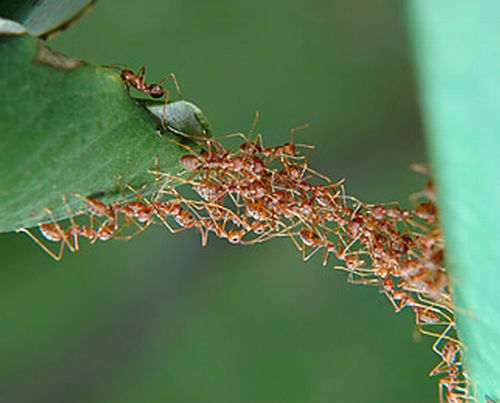
That's right, ants. If we watch a single ant we notice a pattern : there is no pattern. They act rather chaotically and individually, idiosyncratically whimsical. Add a few more ants to the equation and the chaos propagates. There does come a point of critical mass in which there will be enough ants that order begins to rise. These insects develop caste distribution systems and can even preform some extraordinary tasks. For instance, ants, if they need to cross a gap, say from one branch to another (relative to an ant), they will start linking with one another to form a bridge across the gap like an anamorphic particle sponge (that's team work!). Now how can a bunch of stupid individual ants preform such an amazing task? Simple, entropy of stupid declines at a critical number of ants until the intelligence in masses begins to rise.

Now does this occur with humans? Yes. I only need to give three examples to demonstrate the variety of intelligences that reside in the human masses. Since there are different types of intelligences, we will look at three : survival, accuracy (in numbers), and optimal path coordination.
Survival. If one ever reads the Darwin Awards one would know that people do some pretty stupid things that put their own lives in danger (often taking them). So, if we assume that stupidity grows as the masses grow, then how do people survive catastrophes? Let's look at one of the most remarkable example of humans cooperating, staying calm, and working through heavy stress under violent conditions, while ultimately surviving : the terrorists attacks on the World Trade Center on 9/11. Of course, there was some looting and vandalism, but those are mostly outliers. In comparison, there were millions of people who stayed calm (relatively calm for such an event), helped each other out, and cooperated with one another as well as with the authorities. It was so amazing that so many people could work together through such an event that it stunned the media (I still remember CNN wouldn't stop commenting on how cooperative people were being). In fact, the whole nation shaped up. People volunteered, MTV started playing music again (a rather amazing event), and we all started respecting firefighters and police officers for what an immensely difficult job they have.
This is survival through cooperation. Humans are naturally a communal species. We evolved and survived through cooperating in groups. It seems logical that in times of catastrophe we would revert to our primitive instincts that helped us survive over the millenniums : communal cooperation.
So, can we be intelligent in other ways? Yes. In fact, we can even be smarter than an expert on some very fundamental things like guessing the weight of an ox (article here). In the early 1900s Francis Galton, a renowned statistician went to the country fair. While at the fair there was a contest to see who could most accurately guess the weight of an ox. Expert cattle farmers believed they could accurately guess the weight of the ox given their experience, but they were always off by a few pounds. But the layman was even worse, usually being off by many more pounds. But when all the guesses were averaged together the collective guessed the most correct. In other words, the average guess was closer to the actual weight of the ox than the experts on their own.

The other way in which people are intelligent is in pathway coordination. This is something that people are absolutely horrible at when in small groups. Actually in small groups they are worse than when they are by themselves. I am often met with frustration when I am walking down the sidewalk and I am approaching a group of, say, three people, and they walk abreast. I particularly get frustrated when none of them budge and think that I will some how magically walk through them (or vice versa). Then last minute one of them (usually the one I target deliberately) just barely budges and we still collide and the other person gasp in amazement that I would walk right into them. Every had this happen?

Now, if one goes to New York City into a location such as Time Square, aside from it being densely crowded, traffic flow is fairly consistent for a sea of people. In fact, people hardly collide unless someone stops to take a picture. Why is this so? If you watch a high speed video of people walking through Grand Central Terminal at rush hour one would notice something quite extraordinary : there appears to be coherent paths that people follow (an example of this can be found in the Ron Fricke film Chronos). In fact, the paths are so consistent and coherent that they are identical to particle flow. There are a minimum number of paths that are localized on transit vectors from platforms to exits. Note that none of these paths are physical, but rather abstract constructs of human activity. These paths to not intersect, but rather merge and depart, which optimizes the flow of particles / individuals, while avoiding interferences. How does this happen at rush hour with hundreds of thousands of people every hour, but three people cannot accommodate a single individual walking down the sidewalk?

I can really only give an opinion or a guess, but it seems plausible. It is because in the masses usually a single objective is initiated. In 9/11's case it was to survive, and the survival of the individual depended on the survival of the collective. In guessing the ox's weight the collective's objective was strictly guessing the ox's weight. At Grand Central Terminal the objective is to get to work or home as quickly as possible, and the only way to do that is to go with the flow; to go against the grain is to cause delays for yourself, the collective, and if the collective is delayed then that means further delays for the individual.

Additionally, I would suspect that when the collective is focused on a common objective those that go against the grain are easily canceled out, and that everyone striving together to achieve a the common goal will ultimately succeed by sheer numbers alone. This is probably why riots and protests are often successful.


Ad Hoc :
One may think I completely pulled from James Suromiecki's Wisdom of Crowds. Point in fact, I have never read the book. In fact, I have never heard of the book until a moment ago when I was searching for some articles or books on the subject for further research. I was rather stunned that he finds that there are three primary intelligences in masses, and that the ones I discuss are pretty much the same thing. I actually feel like not posting this writing for the simple reason that it is already been discussed elsewhere. But, I will anyway.